Does Atomic Radius Increase or Decrease as You Go Down a Group/family on the Periodic Table
Periodic Trends
- Page ID
- 618
Periodic trends are specific patterns that are present in the periodic table that illustrate different aspects of a certain element, including its size and its electronic properties. Major periodic trends include: electronegativity, ionization free energy, electron affinity, atomic radius, melting betoken, and metallic grapheme. Periodic trends, arising from the arrangement of the periodic table, provide chemists with an invaluable tool to apace predict an chemical element'southward properties. These trends exist because of the similar diminutive structure of the elements within their respective group families or periods, and considering of the periodic nature of the elements.
Electronegativity Trends
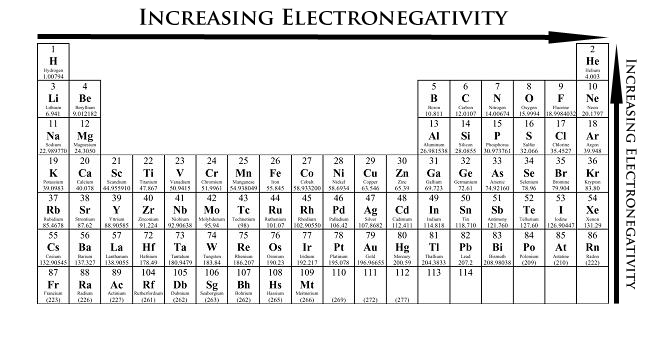
Electronegativity tin can be understood as a chemical property describing an cantlet's ability to concenter and bind with electrons. Because electronegativity is a qualitative holding, in that location is no standardized method for computing electronegativity. Even so, the most common scale for quantifying electronegativity is the Pauling scale (Table A2), named after the pharmacist Linus Pauling. The numbers assigned by the Pauling scale are dimensionless due to the qualitative nature of electronegativity. Electronegativity values for each element tin can exist found on certain periodic tables. An example is provided beneath.
Electronegativity measures an atom's tendency to concenter and form bonds with electrons. This property exists due to the electronic configuration of atoms. Most atoms follow the octet dominion (having the valence, or outer, shell comprise of 8 electrons). Because elements on the left side of the periodic tabular array have less than a half-full valence shell, the energy required to proceeds electrons is significantly higher compared with the energy required to lose electrons. As a result, the elements on the left side of the periodic tabular array generally lose electrons when forming bonds. Conversely, elements on the right side of the periodic table are more energy-efficient in gaining electrons to create a consummate valence crush of viii electrons. The nature of electronegativity is finer described thus: the more than inclined an atom is to gain electrons, the more likely that cantlet will pull electrons toward itself.
- From left to right across a period of elements, electronegativity increases. If the valence shell of an cantlet is less than half total, it requires less free energy to lose an electron than to gain ane. Conversely, if the valence beat is more than half full, it is easier to pull an electron into the valence shell than to donate i.
- From peak to lesser down a group, electronegativity decreases. This is considering atomic number increases downwards a grouping, and thus at that place is an increased distance between the valence electrons and nucleus, or a greater atomic radius.
- Important exceptions of the above rules include the noble gases, lanthanides, and actinides. The noble gases possess a consummate valence vanquish and exercise not normally attract electrons. The lanthanides and actinides possess more than complicated chemistry that does non generally follow whatever trends. Therefore, noble gases, lanthanides, and actinides do not take electronegativity values.
- As for the transition metals, although they have electronegativity values, there is little variance among them across the period and up and down a group. This is considering their metal properties affect their ability to attract electrons as hands every bit the other elements.
According to these 2 general trends, the most electronegative element is fluorine , with 3.98 Pauling units.
Ionization Free energy Trends
Ionization energy is the energy required to remove an electron from a neutral atom in its gaseous phase. Conceptually, ionization energy is the reverse of electronegativity. The lower this free energy is, the more readily the atom becomes a cation. Therefore, the higher this energy is, the more unlikely it is the atom becomes a cation. By and large, elements on the right side of the periodic table have a college ionization energy considering their valence trounce is nearly filled. Elements on the left side of the periodic table have depression ionization energies because of their willingness to lose electrons and become cations. Thus, ionization free energy increases from left to right on the periodic table.
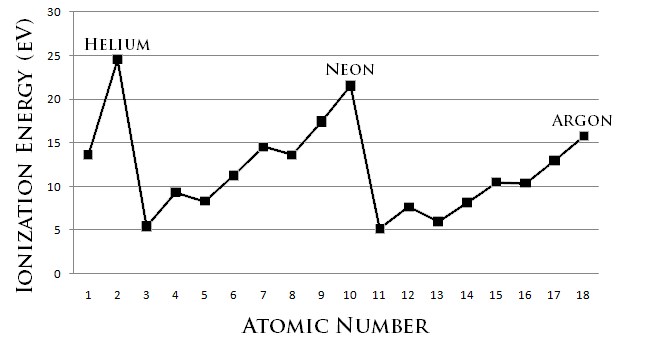
Another gene that affects ionization free energy is electron shielding. Electron shielding describes the ability of an atom's inner electrons to shield its positively-charged nucleus from its valence electrons. When moving to the right of a menstruum, the number of electrons increases and the strength of shielding increases. As a result, information technology is easier for valence shell electrons to ionize, and thus the ionization energy decreases downwardly a group. Electron shielding is likewise known as screening.
Trends
- The ionization energy of the elements within a menstruation generally increases from left to right. This is due to valence shell stability.
- The ionization energy of the elements within a group generally decreases from elevation to lesser. This is due to electron shielding.
- The noble gases possess very high ionization energies because of their full valence shells every bit indicated in the graph. Notation that helium has the highest ionization energy of all the elements.
Some elements have several ionization energies; these varying energies are referred to as the first ionization free energy, the second ionization energy, third ionization energy, etc. The commencement ionization energy is the energy requiredto remove the outermost, or highest, energy electron, the 2nd ionization energy is the energy required to remove any subsequent loftier-energy electron from a gaseous cation, etc. Below are the chemical equations describing the first and second ionization energies:
First Ionization Energy:
\[ X_{(m)} \rightarrow X^+_{(chiliad)} + e^- \]
Second Ionization Energy:
\[ X^+_{(m)} \rightarrow Ten^{two+}_{(g)} + e^- \]
Generally, any subsequent ionization energies (2d, 3rd, etc.) follow the same periodic trend as the first ionization energy.

Ionization energies decrease as atomic radii increase. This observation is affected by \(due north\) (the main quantum number) and \(Z_{eff}\) (based on the diminutive number and shows how many protons are seen in the cantlet) on the ionization energy (I). The relationship is given past the following equation:
\[ I = \dfrac{R_H Z^2_{eff}}{n^2} \]
- Across a period, \(Z_{eff}\) increases and due north (principal quantum number) remains the same, and so the ionization free energy increases.
- Down a group, \(n\) increases and \(Z_{eff}\) increases slightly; the ionization energy decreases.
Electron Affinity Trends
Every bit the name suggests, electron affinity is the power of an atom to accept an electron. Different electronegativity, electron analogousness is a quantitative measurement of the energy modify that occurs when an electron is added to a neutral gas atom. The more negative the electron affinity value, the higher an atom's affinity for electrons.
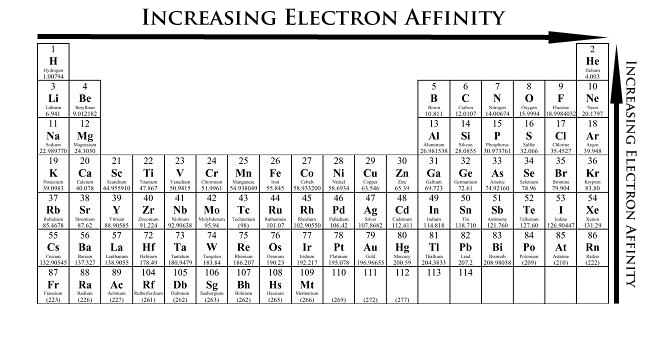
Electron affinity generally decreases downwardly a group of elements because each atom is larger than the atom to a higher place it (this is the atomic radius trend, discussed beneath). This means that an added electron is farther away from the cantlet's nucleus compared with its position in the smaller atom. With a larger distance betwixt the negatively-charged electron and the positively-charged nucleus, the force of attraction is relatively weaker. Therefore, electron affinity decreases. Moving from left to right beyond a menstruum, atoms become smaller as the forces of attraction become stronger. This causes the electron to motility closer to the nucleus, thus increasing the electron affinity from left to right across a period.
- Electron affinity increases from left to right within a period. This is acquired by the decrease in atomic radius.
- Electron affinity decreases from top to bottom within a grouping. This is acquired past the increment in diminutive radius.
Atomic Radius Trends
The atomic radius is half the distance between the nuclei of two atoms (just like a radius is one-half the bore of a circumvolve). Withal, this idea is complicated past the fact that non all atoms are usually bound together in the same way. Some are bound by covalent bonds in molecules, some are attracted to each other in ionic crystals, and others are held in metal crystals. Nevertheless, information technology is possible for a vast majority of elements to form covalent molecules in which two like atoms are held together by a unmarried covalent bail. The covalent radii of these molecules are often referred to equally atomic radii. This altitude is measured in picometers. Atomic radius patterns are observed throughout the periodic table.
Atomic size gradually decreases from left to right across a period of elements. This is because, within a menses or family unit of elements, all electrons are added to the same beat. However, at the aforementioned fourth dimension, protons are being added to the nucleus, making it more than positively charged. The effect of increasing proton number is greater than that of the increasing electron number; therefore, in that location is a greater nuclear attraction. This ways that the nucleus attracts the electrons more strongly, pulling the atom'due south shell closer to the nucleus. The valence electrons are held closer towards the nucleus of the cantlet. As a consequence, the atomic radius decreases.
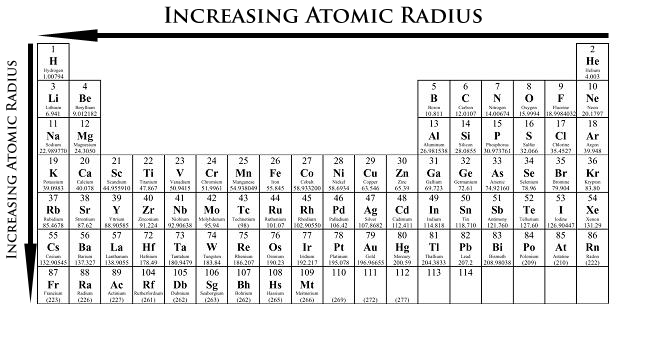
D ain a group, diminutive radius increases. The valence electrons occupy higher levels due to the increasing breakthrough number (n). As a result, the valence electrons are farther abroad from the nucleus every bit 'northward' increases. Electron shielding prevents these outer electrons from beingness attracted to the nucleus; thus, they are loosely held, and the resulting atomic radius is big.
- Atomic radius decreases from left to right inside a period. This is caused by the increase in the number of protons and electrons across a menstruum. Ane proton has a greater effect than ane electron; thus, electrons are pulled towards the nucleus, resulting in a smaller radius.
- Atomic radius increases from top to bottom inside a group. This is acquired past electron shielding.
Melting Indicate Trends
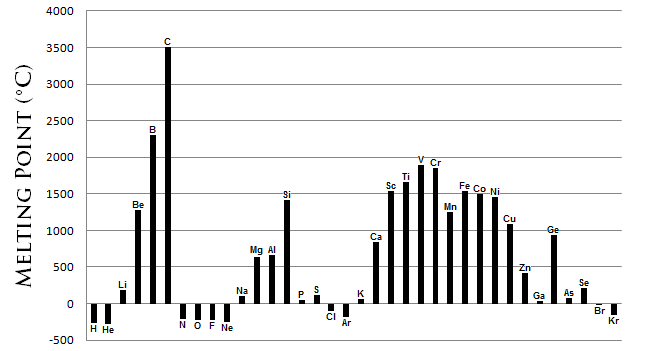
The melting points is the amount of energy required to break a bail(s) to modify the solid phase of a substance to a liquid. Generally, the stronger the bond between the atoms of an element, the more energy required to break that bond. Because temperature is straight proportional to energy, a high bond dissociation free energy correlates to a high temperature. Melting points are varied and do not generally form a distinguishable trend across the periodic table. Nevertheless, certain conclusions can be fatigued from Figure \(\PageIndex{seven}\).
- Metals generally possess a high melting bespeak.
- About non-metals possess low melting points.
- The non-metal carbon possesses the highest melting point of all the elements. The semi-metal boron also possesses a loftier melting point.
Metallic Character Trends
The metallic character of an element can be defined as how readily an atom can lose an electron. From correct to left across a period, metallic graphic symbol increases because the attraction betwixt valence electron and the nucleus is weaker, enabling an easier loss of electrons. Metallic character increases as you movement downward a group considering the diminutive size is increasing. When the atomic size increases, the outer shells are farther away. The primary quantum number increases and boilerplate electron density moves farther from nucleus. The electrons of the valence shell have less allure to the nucleus and, as a outcome, can lose electrons more readily. This causes an increase in metallic character.
- Metal characteristics decrease from left to right across a menses. This is caused by the decrease in radius (caused by Zeff, every bit stated above) of the atom that allows the outer electrons to ionize more readily.
- Metallic characteristics increase down a group. Electron shielding causes the atomic radius to increase thus the outer electrons ionizes more readily than electrons in smaller atoms.
- Metal grapheme relates to the power to lose electrons, and nonmetallic character relates to the ability to gain electrons.
Another easier way to remember the trend of metallic graphic symbol is that moving left and downwards toward the bottom-left corner of the periodic tabular array, metallic grapheme increases toward Groups one and 2, or the alkali and alkaline earth metal groups. Likewise, moving up and to the right to the upper-right corner of the periodic table, metallic character decreases because y'all are passing by to the right side of the staircase, which point the nonmetals. These include the Group 8, the noble gases, and other common gases such equally oxygen and nitrogen.
- In other words:
- Move left across menstruum and down the grouping: increase metallic character (heading towards alkali and alkaline metals)
- Motility correct beyond period and up the group: decrease metallic graphic symbol (heading towards nonmetals like noble gases)

Issues
The following series of issues reviews general understanding of the aforementioned material.
1. Based on the periodic trends for ionization energy, which element has the highest ionization energy?
- Fluorine (F)
- Nitrogen (N)
- Helium (He)
2.) Nitrogen has a larger atomic radius than oxygen.
- A.) True
- B.) Imitation
iii.) Which has more metallic character, Lead (Lead) or Can (Sn)?
4.) Which element has a college melting point: chlorine (Cl) or bromine (Br)?
5.) Which element is more than electronegative, sulfur (S) or selenium (Se)?
6) Why is the electronegativity value of nigh noble gases zero?
7) Adapt these atoms in order of decreasing effective nuclear accuse by the valence electrons: Si, Al, Mg, S
8) Rewrite the following list in order of decreasing electron analogousness: fluorine (F), phosphorous (P), sulfur (South), boron (B).
9) An cantlet with an diminutive radius smaller than that of sulfur (S) is __________.
- A.) Oxygen (O)
- B.) Chlorine (Cl)
- C.) Calcium (Ca)
- D.) Lithium (Li)
- Eastward.) None of the above
10) A nonmetal has a smaller ionic radius compared with a metal of the aforementioned period.
- A.) True B.) False
Solutions
1. Answer: C.) Helium (He)
Explanation: Helium (He) has the highest ionization energy because, like other noble gases, helium'southward valence shell is full. Therefore, helium is stable and does not readily lose or gain electrons.
2. Reply: A.) True
Explanation: Atomic radius increases from right to left on the periodic table. Therefore, nitrogen is larger than oxygen.
three. Reply: Lead (Lead)
Caption: Atomic number 82 and tin share the same column. Metal character increases down a column. Atomic number 82 is under tin can, and then atomic number 82 has more metal character.
4. Answer: Bromine (Br)
Caption: In non-metals, melting point increases down a column. Because chlorine and bromine share the same cavalcade, bromine possesses the higher melting betoken.
five. Reply: Sulfur (S)
Explanation: Note that sulfur and selenium share the same column. Electronegativity increases up a column. This indicates that sulfur is more than electronegative than selenium.
6. Answer: About noble gases have full valence shells.
Explanation: Because of their full valence electron crush, the noble gases are extremely stable and do non readily lose or gain electrons.
7. Answer: S > Si > Al > Mg.
Explanation: The electrons in a higher place a closed shell are shielded by the airtight crush. S has 6 electrons above a closed trounce, so each one feels the pull of 6 protons in the nucleus.
eight. Answer: Fluorine (F)>Sulfur (S)>Phosphorous (P)>Boron (B)
Explanation: Electron affinity generally increases from left to right and from bottom to top.
9. Answer: C.) Oxygen (O)
Caption: Periodic trends indicate that diminutive radius increases upwardly a grouping and from left to correct across a menses. Therefore, oxygen has a smaller atomic radius sulfur.
10. Reply: B.) False
Explanation: The reasoning behind this lies in the fact that a metal usually loses an electron in becoming an ion while a non-metal gains an electron. This results in a smaller ionic radius for the metal ion and a larger ionic radius for the non-metallic ion.
References
- Pinto, Gabriel. "Using Assurance of Different Sports To Model the Variation of Atomic Sizes." J. Chem. Educ. 1998 75 725.{cke_protected}{C}
- Qureshi, Pushkin Grand.; Kamoonpuri, South. Iqbal M. "Ion solvation: The ionic radii problem." J. Chem. Educ. 1991, 68, 109.
- Smith, Derek W. "Atomization enthalpies of metallic elemental substances using the semi-quantitative theory of ionic solids: A simple model for rationalizing periodic trends." J. Chem. Educ. 1993, 70, 368.
- Russo, Steve, and Mike Argent. Introductory Chemical science. San Francisco: Pearson, 2007.
- Petrucci, Ralph H, et al. General Chemical science: Principles and Modern Applications. 9th Ed. New Jersey: Pearson, 2007.
- Atkins, Peter et. al, Physical Chemistry, seventh Edition, 2002, W.H Freeman and Company, New York, pg. 390.
- Alberty, Robert A. et. al, Physical Chemistry, threerd Edition, 2001, John Wiley & Sons, Inc, pg. 380.
- Kots, John C. et. al, Chemistry & Chemical Reactivity, 5th Edition, 2003, Thomson Learning Inc, pg. 305-309.
Contributors and Attributions
- Swetha Ramireddy (UCD), Bingyao Zheng (UCD), Emily Nguyen (UCD)
Source: https://chem.libretexts.org/Bookshelves/Inorganic_Chemistry/Supplemental_Modules_and_Websites_(Inorganic_Chemistry)/Descriptive_Chemistry/Periodic_Trends_of_Elemental_Properties/Periodic_Trends
0 Response to "Does Atomic Radius Increase or Decrease as You Go Down a Group/family on the Periodic Table"
Post a Comment