How Do You Know if Therer Rock Where Your Diging Without Diging
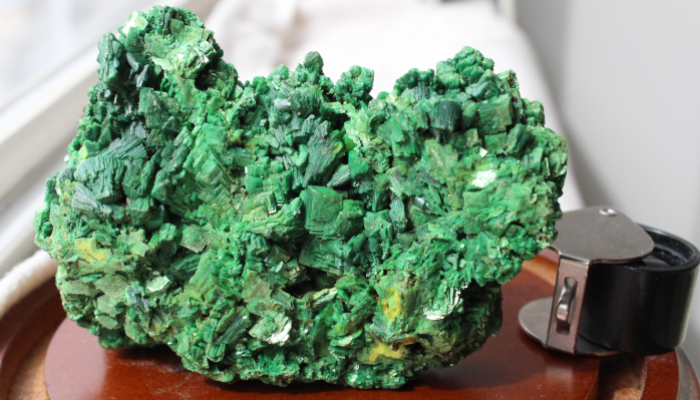
Torbernite crystals from Van's stone collection
Near of the states accept been direct or indirectly involved in outreach activities, frequently relying on shiny rocks to capture people's fascination. This week, Aaron Van Alstine, a member of the Memphis Archaeological and Geological Social club, a passionate rockhounder, and moderator of the sub-reddit on radioactive rocks, shares his views on why all earth scientists need a stone collection and how to start information technology.
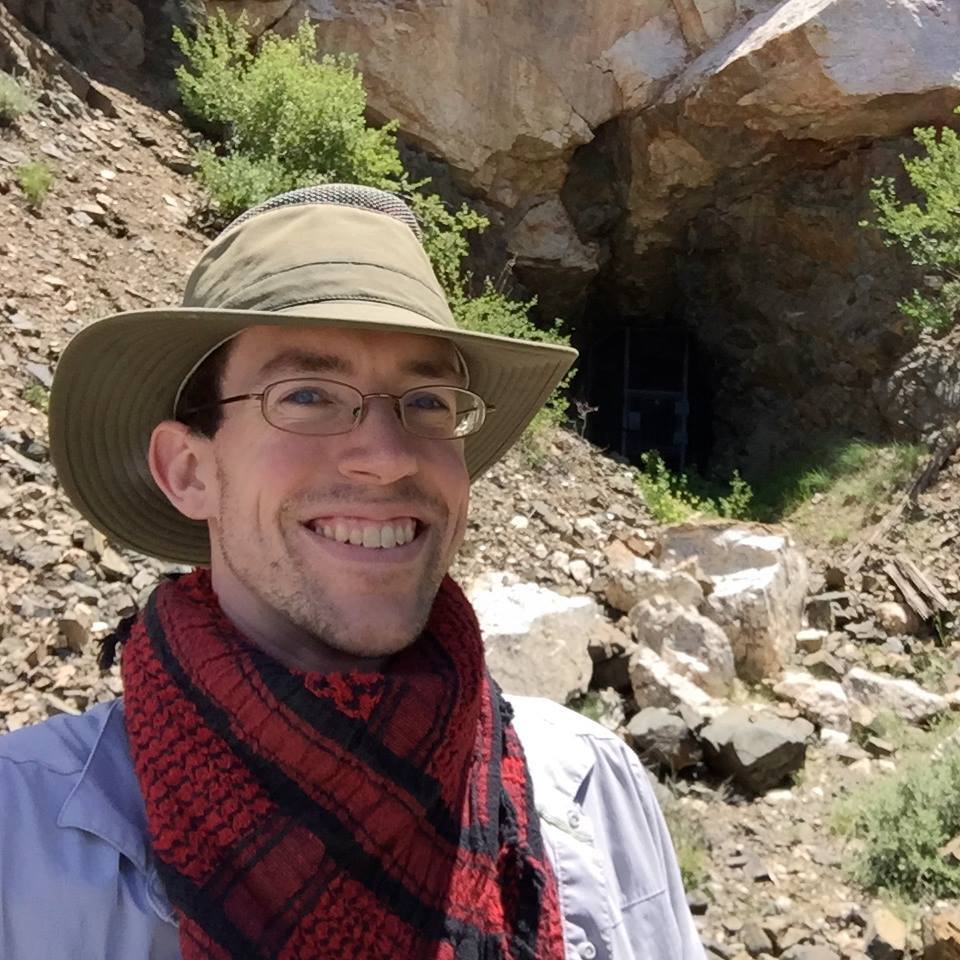 When I first met my wife, who was at that time doing her doctoral work in geophysics, I excitedly blurted out the question that immediately springs to everybody's mind when they meet a real-life globe scientist: "How big is your rock collection?"
It knocks the wind out of your sails when you ask a genuine, enthusiastic question from the middle and the other person merely stares at you like yous have three heads. My wife, it turns out, did not have a rock drove. Not only that, merely the idea of collecting rocks had never even crossed her mind. And over the grade of fourth dimension, I fabricated a startling discovery: many geophysicists practise not take a rock collection.
People have certain expectations that professionals will comprehend the symbolism of their work. If a pic protagonist is seated in a doctor's office, at that place will undoubtedly be a human skeleton grinning in the corner; if the hero goes to conversation with an astrophysicist well-nigh deflecting an incoming asteroid, she will with absolute certainty take a meteorite paperweight on her desk. Lawyers have their leather-bound encyclopedia sets, artists accept their lopsided berets, and pirates have their trained parrots and crippling alcoholism. Y'all have an obligation to present yourself to the public in a sure way, and frankly every bit a grouping, I think geophysicists have been coming up brusque.
Fortunately, this faux pas is easily rectified, and I've been asked to address some FAQs that might come up equally you begin to surround yourself with the trappings of your profession.
Q: How did YOU beginning collecting rocks?
My grandfather, a hilarious mountain of a man who once fabricated a living as a geologist and civil engineer, helped me start my rock collection as shortly as I was old enough to be trusted not to put the petty ones up my nose. Every bit he used to say, it'southward important for a young man to have a Proper Hobby to keep him outdoors and out of problem. So, he presented me with a couple dozen specimens he'd come up across in his travels; more often than not self-collected, with the rest probably purchased at diverse stone shops. My collection remained fairly reasonably sized until I discovered that rather than but filling up a jar with crinoid stems gathered by the railroad tracks, you can relieve your credit card number and simply have your friendly local postal worker bring you a box with astonishing sparkly treasures from far-flung localities – something helpful when nigh of the geology in a 3-hour radius can be concisely described equally "mainly mud".
Q: How do you lot go most finding rocks outdoors?
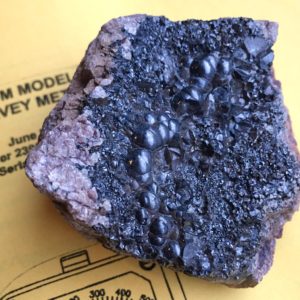
Uraninite from Pribram, CZ. A very "hot" specimen from Van'due south favorites.
Find collecting sites by using a rockhound's guidebook, give-and-take of rima oris, or your favorite cyberspace browser. I'd highly recommend joining a local geology guild. Even for those folks lucky enough to live in the right geographic expanse to collect pick specimens, it's nice to take somebody testify you lot the ropes to safely, legally, and successfully rockhound. Clubs frequently take periodic outings – including to sites off-limits to the full general public – and having somebody show you lot what you should be looking for saves a lot of time and effort.
Equipment needs vary by site; hunting for fossils in a stony riverbed might only require a strong backpack and some paper towels to protect your finds, whereas yous might non be very successful in a hard stone quarry without a purpose-made rock hammer and eye protection. Bring weather-appropriate gear, enough of h2o, and brand sure to tell somebody your itinerary and expected fourth dimension of render. Read up on state and federal rockhounding laws, always secure landowner permission to dig, and follow the Rockhounding Code of Ethics.
Q: What is your favorite mineral?
I'm a large fan of Uraninite, UO2. It can take on an assortment of shapes, but information technology'south ever satisfyingly dense and jet black. The radioactive decay from Uranium and its daughter products is potentially hazardous, but not likely to be an consequence with just a few thumbnail-sized samples – provided you don't lick them, snort them, or slumber with them nether your pillow.
Q: Are there any rocks out there for folks more interested in Deep Earth?
Glad yous asked. The nearly obvious answer is Olivine/Peridot, which in the collecting community is ordinarily encountered equally "bombs" of greenish crystalline material yakked out of the mouth of a volcano. Even more interestingly, Olivine also forms crystals in a sure grade of Iron-rich meteorites called Pallasites. Cut and polished into a thin slab and held up to bright light, yous tin can see a fascinating "stained glass" effect of dark-green crystals glimmering in the metal matrix; I've been told belongings a specimen is basically as close equally yous'll ever come to touching the core-curtain purlieus.
Another interesting feature relevant to geophysicists is Slickensides, which grade where two sides of a mistake outset to grind confronting each other. Frequently this occurs every bit recognizable striations, with or without secondary mineral overgrowth, but rarely movement in multiple planes can grind the opposing faces to a near-mirror end.
I'd also be remiss to forget about Kimberlite. Yous aren't probable to find a sizeable diamond in any Kimberlite yous come across, simply as higher up I've been told that the experience of actually holding a piece of rock that, over the form of a few hours made the journey from "impossibly deep" to "y'all can literally agree a chunk of it", is transformative.
Q: What does Geodynamics mean to y'all?
I really don't know. As far as I can tell, Geodynamics is something that happens when people blazon Greek letters into a estimator and hitting 'Run', then walk abroad for a 24-hour interval while the computer makes funny noises and gets extremely hot. Perchance some discussion of faults, boundaries, and earthquakes emerges afterwards, but more commonly it seems to exist a stream of impressively graphic curses and rude statements most the calculator's motherboard.
Q: Any final advice?
I only ask you to consider your professional image to the public. Gordon Ramsay without the apron is only an English jerk yelling at the people feeding him; please put your proverbial frock on and at least brandish a few minerals in your role. Whether information technology's the colour, the luster, the density, or the origin – there's something in the rockhounding hobby for everybody to appreciate.
Source: https://blogs.egu.eu/divisions/gd/2021/09/01/when-not-digging-code-dig-rocks/
0 Response to "How Do You Know if Therer Rock Where Your Diging Without Diging"
Post a Comment